
New Student Shopping Cart

He said I have to buy one of those spinny things? - Student Pilot
Congratulations, you've decided to begin your journey to become a private pilot. As all things, you will need to purchase some class materials. Let's make a list
together!
1) Electronic Flight Bag (EFB)
Once upon a time, pilots had to do a lot of work "by hand". Today, many pilot tasks are replaced by an EFB which has your digital charts, weigth and balance functions, flight planning tools, and a lot more. There are many to choose from, the most famous being Garmin Pilot and Foreflight. Both are in the form of iPad/iPhone applications, and have a respective web version, too. To be completely fair, you can learn even without it, but given today's day and age, I would argue it's an appropriate resource to have.
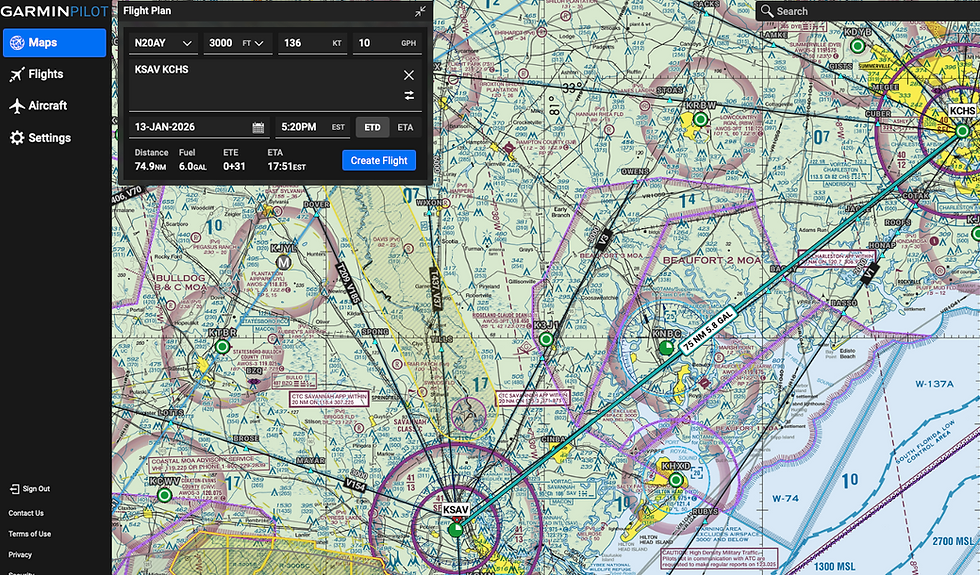
I am a big supporter of Garmin Pilot, primarily since I used to work for Garmin and I'm therefore totally biased. What I recommend is you look up Youtube videos of both and then sign up for a free trial of both. See which one you like best. You will see me use primarily Garmin Pilot (even as a corporate pilot).
2) Logbook
The logbook is a book where you "log" all of your flights. As you progress through training, each flight needs to be appropriately logged so that you have a record of your experience. You are required to "show" that experience when you take exams. Many pilots like to have a physical logbook, while others will only use a digital one. I personally use both a physical and a digital through Garmin Pilot (my EFB). That's right, if you choose to purchase an EFB (see item #1), you will automatically also have a digital logbook. The logbook is an official record, so keep in mind that it's a rather important part of your life as a pilot.

3) Headset
In order to communicate in the cockpit with air traffic control (ATC) and your instructor, you will need a headset. There are hundreds to choose from. I won't recommend one over the other, but I will say that an active noise canceling (ANC) headset is the way to go. I personally use the Bose A20 with bluetooth. It allows you to connect your devices like your phone, which can be very helpful in emergency situations. You can also listen to music, if appropriate (my buddy Ethan listened to music during his checkride, but that's a story for another time). They cost a lot, but it's an investment for your future (also, I bought mine in 2012 and they still work great). Oh, make sure it has the DUAL plug (two jacks) for most airplanes. If you will fly Cirrus or some other advanced aircraft, ask your instructor before purchasing.

4) Kneeboard
When we fly, we constantly need to write stuff down. Frequencies, instructions, weather information, etc. There's a myriad of kneeboards to choose from. FlyBoys seems to be the new fashion among young student pilots. Your EFB has a scratchpad function, so I'm ok if you choose to use your EFB itself. However, if you choose to use an EFB, I recommend you install the EFB on an iPad. The iPhone tends to be too small. You want to have a large enough screen that you can place on your knee and read, write, etc. on it. If you elect to use an iPad with Garmin Pilot or Foreflight, I recommend a leg strap of sorts (like this one) to secure the iPad to your leg.


5) Ground School
Flight training occurs mainly in two ways: (1) ground school and (2) flight lessons. The first is all the theoretical knowledge that must be learned in a classroom environment. The latter is the actual lesson in the airplane. For ground school, there are multiple ways to go by it. Your instructor can teach you everything or you can purchase online training (that can be completed on your own time wherever you want). The ground school I personally recommend is King Schools. They are a little old school, but they are high quailty. I also worked with them on some regulatory issue, so I got to know them. The benefit is obviously that you get to complete it whenever and wherever you want without needing to schedule time with your instructor. However, keep in mind that a good instructor will still require some ground lessons with you. Another thing to keep in mind is whether your school is Part 141 or Part 61. Part 61 instruction is not a problem. For Part 141, your instructor is required to give you the ground school training, unless there is permission between the school and the FAA. Make sure to ask your flight school, if in doubt. What I pesonally recommend is to purchase a ground school either way, and then do some ground lessons with your instructor, too. The ground school is designed to help you pass your FAA written exam. Well, that is an online standardized test similar to the SAT. You need to learn how to take it as well as the material. An online ground school is great at doing just that.
6) Flight Calculator (E6B)
An E6B is a flight calculator. Although your EFB will do most of your flight planning calculations, you will still need to demonstrate knowledge of aviation math. This will be evident on your FAA written exam (yup, you need math), but your instructor will also need to show you how your EFB computes all the math. And, if you're one of my students, you'll need to do math in-air (muahahaha!). You can purchase an electronic E6B (it looks like a calculator) or a "Wiz Wheel", which is the paper physical version. Either are perfectly fine, however I prefer the wiz wheel... it is somewhat elegant... ;)

7) Flashlight
You will need to complete a certain amount of night flying. As part of this, you will need a flashlight that has both "white" and "red" lights. The white is for preflight, postflight, etc. The red light is to preserve your night vision, so it's used while in-flight.
8) FAR/AIM
The FAR/AIM is the regulatory bible for pilots. FAR = Federal Aviation Regulations and AIM = Aeronautical Information Manual. This book can be found in multiple ways. It can be a physical copy (it gets issue every year, though, so it will be obsolete next year), there are apps for your phone/iPad that do the same, or you can also search online on the faraim.org website.
9) Pilot's Handbook of Aeronautical Knowledge (PHAK)
It's a book that talks about aeronautical knowledge: aerodynamics, aircraft systems, and lots more. You can buy a physical copy or get the free PDF online from the FAA.
10) Airplane Flying Handbook (AFH)
It's a book that talks about maneuvers, traffic patterns, and lots more for your training. You can buy a phsyical copy or get the free PDF online from the FAA.


Comments